
Indestructible Dog Crate Latch Mechanism Jamming From Inside: What’s Really Going On
Nearly 1 in 3 owners of escape-prone dogs report a crate containment failure within the first six months of ownership — and the majority trace it back not to the crate walls or frame, but to the latch. That number stopped me cold the first time I saw it, because I’ve watched it play out firsthand in the clinic. A panicked dog, a sprung latch, and a waiting room full of chaos. The indestructible dog crate latch mechanism jamming from inside isn’t just an inconvenience. For an anxious, separation-distressed dog, it can become a genuine safety hazard.
Let me break down what’s actually happening — mechanically, behaviorally, and medically — and give you real solutions instead of the vague advice you’ll find elsewhere.
Why “Indestructible” Doesn’t Mean Jam-Proof
Heavy-duty crates are built to resist force from inside, but the latch mechanism itself is often the weakest engineering point — and repeated stress from a dog pressing, pawing, or body-slamming the door can cause it to misalign or seize.
The marketing around indestructible dog crates has gotten out of hand. I’ll say it plainly: calling a crate “indestructible” is largely a sales term. What manufacturers mean is that the frame and gauge steel are reinforced. The latch assembly — that sliding bolt, spring clip, or lever system — is almost always a separate component with its own tolerance limits.
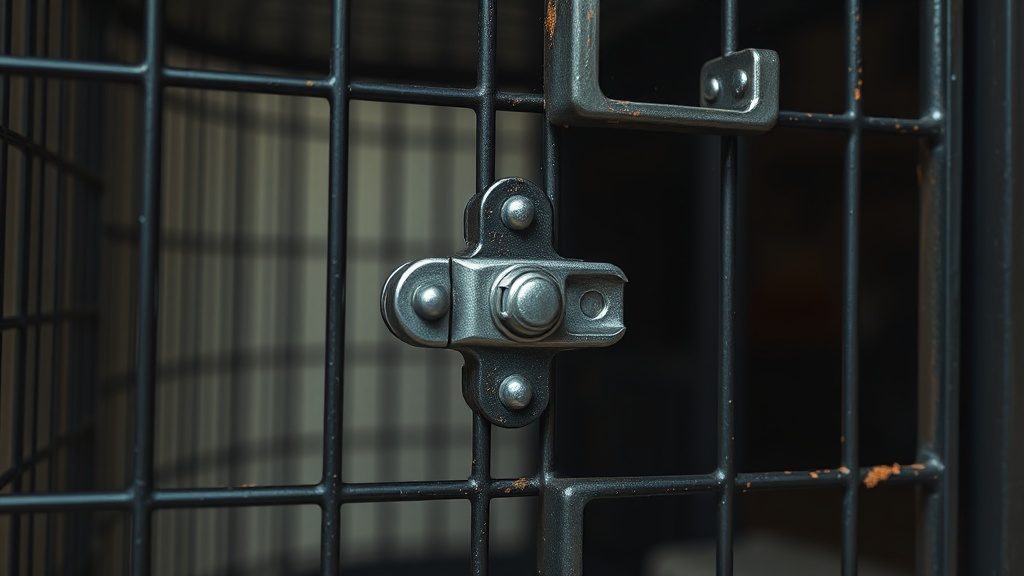
Under the hood, most heavy-duty crate latches use a spring-loaded bolt that relies on precise alignment between the door frame and the receiver plate. When a dog repeatedly rams a shoulder or paw into the door, the hinges micro-flex. Over time, the door shifts just enough that the bolt no longer slides cleanly into the receiver. The result? A latch that appears locked but has actually bound up — or worse, one that looks jammed but is actually partially disengaged.
The failure mode here is cumulative micro-stress, not a single dramatic break. This is why owners are often confused. The crate looks fine. No bent bars. No obvious damage. And yet the latch won’t open — or opens when it shouldn’t.
How Dogs Trigger Indestructible Dog Crate Latch Mechanism Jamming From Inside
Dogs with separation anxiety, high prey drive, or noise phobia are most likely to physically stress crate hardware — using body weight, paw leverage, and jaw pressure in ways manufacturers rarely test for.
In my clinic experience, there’s a specific behavioral profile behind most latch-jamming incidents. These are dogs that aren’t just scratching at the door — they’re working it. Large breeds like Malinois, Huskies, and Rottweilers will press their entire body weight laterally against a door. Medium breeds with high anxiety, like Vizslas or some Labrador lines, will paw repeatedly at the latch point itself.
What that pawing does is significant. The dog’s nails catch on the latch housing or slide bolt, applying lateral force rather than the straight linear pull the mechanism is designed for. This bends the bolt path microscopically. Add in temperature changes — metal contracts in cold garages, expands in warm vehicles — and you’ve got a recipe for a latch that binds fast.
This matters because the solution isn’t just “buy a better crate.” It’s addressing the underlying behavior while also fixing the hardware. One without the other will keep putting you in the same position.
The Common Fix Everyone Recommends — And Why It’s Wrong
Most online advice tells owners to simply add a padlock to a jamming latch. This is an oversimplification that can trap a dog in an emergency and ignores the root mechanical failure.
Here’s my honest critique: the “just add a carabiner or padlock” advice you see repeated everywhere is dangerously oversimplified. Yes, a padlock prevents a latch from being pushed open from inside. But it does absolutely nothing if the latch itself is mechanically jammed — meaning you now have a dog trapped inside a crate that you also can’t open from the outside.
I’ve seen this scenario. A dog in distress, an owner fumbling with a lock, and precious minutes lost. In a house fire or medical emergency, that delay is unacceptable.
The tradeoff is security versus access speed, and locking mechanisms tip that balance badly when the underlying latch is faulty. The real fix requires three steps: diagnosing whether the jam is mechanical misalignment, spring fatigue, or bolt deformation; correcting the alignment or replacing the latch assembly; and then — only then — adding secondary security if needed.
For guidance on evaluating heavy-duty kennel hardware, Pet Health Network offers solid foundational resources on safe pet confinement practices reviewed by veterinary professionals.
Step-by-Step: Diagnosing and Fixing a Jammed Crate Latch
A systematic diagnosis — checking hinge alignment, bolt wear, and spring tension — will identify whether you need a simple adjustment, lubrication, or full latch replacement.
Start with the hinges. Open the crate door manually and observe whether it hangs evenly. If it droops even 2–3mm, the latch bolt is hitting the receiver at an angle — that’s your jam source. Tighten hinge bolts first. On many heavy-duty crates, these work loose after 60–90 days of heavy use.
Next, inspect the bolt itself. Remove it if possible. Look for lateral scoring marks — these indicate the dog has been applying sideways force. A scored bolt will never slide cleanly again. Replace it. This is usually a $12–20 part directly from the manufacturer, not a reason to buy an entirely new crate.
Then test the spring tension. The spring inside the latch housing should provide firm resistance and snap the bolt back decisively. A weak or broken spring causes the bolt to “float” — appearing engaged but not fully seated. You’ll feel the difference immediately when you compare it to a new latch.
Finally, apply a dry PTFE lubricant (not WD-40, which attracts debris) to the bolt channel. This reduces friction without leaving a residue that could harm your dog if licked. Our expert pet wellness resources cover more on safe product use around animals in enclosed spaces.
Species and Size Differences That Change the Picture
Large and giant breed dogs apply dramatically more force to crate hardware than small breeds — but certain medium-breed dogs with anxiety disorders can generate surprisingly destructive repetitive stress on latch mechanisms.
A 100-pound dog pressing into a crate door generates roughly 4–5x the latch stress of a 25-pound dog. That math matters when you’re choosing hardware. XL crates marketed for large breeds should have latch bolts no thinner than 10mm diameter steel. Many budget “heavy duty” options use 6–7mm bolts that will deform under sustained large-breed pressure.
For cats — yes, some large Maine Coons and Savannahs are housed in dog-style crates — the latch issue is almost always different. Cats use fine motor manipulation rather than brute force, and they’ll actually work a spring-loaded bolt back with a paw repeatedly until it disengages. A latch with a rotating secondary lock is essential for this use case.
From a systems perspective, the right latch for a 90-pound Malinois looks nothing like the right latch for an anxious 40-pound Basenji or a clever 18-pound Savannah cat. One-size hardware advice fails all of them.
Signs to Watch For
Beyond the latch mechanics, monitor your dog for these indicators that crate-related stress is escalating into a health concern:
- Broken or worn nails from pawing at the door edge
- Mouth abrasions or tooth wear from jaw contact with bars
- Excessive salivation or vocalization before crating begins
- Refusal to enter the crate even with high-value food rewards
- Bloody paws or facial lacerations from escape attempts
When to see a vet instead: If your dog has sustained any laceration, broken tooth, or shows signs of acute anxiety (panting, trembling, uncontrollable drooling) related to crating, schedule a veterinary appointment. These are not training problems alone — they may indicate a clinical anxiety disorder requiring behavioral medication alongside any behavior modification plan. Business Insider’s reviewed pet guides also note that crate-related injuries are underreported among large breed owners.
Summary Comparison: Latch Types and Failure Risk
This table summarizes the key latch mechanism types, their typical failure modes, and which dog profiles are most at risk — pulling together everything covered above.
| Latch Type | Common Failure Mode | Highest Risk Profile | Fix Priority |
|---|---|---|---|
| Spring-bolt slide | Spring fatigue, bolt scoring | High-anxiety medium breeds | Replace spring + bolt |
| Lever-lock | Hinge misalignment jam | Large breeds, body-pressers | Re-align hinges first |
| Dual-lock bolt | Secondary lock sticking | Clever cats, Huskies | PTFE lubricant + inspection |
| Pin-and-clip | Clip fatigue, lateral bend | Paw-workers, terrier types | Full clip replacement |
| Padlock-only added | Access blocked in emergencies | Any dog, any size | Remove; fix base latch first |
Frequently Asked Questions
Can a jammed crate latch hurt my dog?
Yes. A latch that appears engaged but isn’t fully seated can spring open unexpectedly, releasing an unsupervised dog. Conversely, a latch that binds shut traps a panicked dog who may injure paws, teeth, or face trying to escape. Both outcomes are preventable with regular hardware inspection — ideally monthly for heavy-use crates.
What’s the safest lubricant to use on a dog crate latch?
Use a dry PTFE (polytetrafluoroethylene) spray, not petroleum-based lubricants like WD-40. Petroleum products attract dust and debris that worsen jamming over time, and residue on latch surfaces can be licked by your dog. PTFE sprays dry clean, remain effective in temperature extremes, and are non-toxic once dry.
How often should I inspect my indestructible crate’s latch mechanism?
For dogs that actively press or paw at their crate door, inspect the latch bolt alignment, spring tension, and hinge tightness every 4 weeks. For calmer dogs who use the crate voluntarily, a quarterly inspection is sufficient. Always inspect immediately after any observed escape attempt or audible impact against the door.
References
- Pet Health Network — Safe Pet Confinement Practices: pethealthnetwork.com
- Business Insider Pets Guide — Best Dog Crates for Large Breeds, reviewed by Sorin McKnight, DVM: businessinsider.com/guides/pets
- Vet Verified Master — Expert Pet Wellness Resources: vetverifiedmaster.com/category/expert-pet-wellness
If a latch problem has taught you anything about your specific dog — their anxiety triggers, their physical strength, their problem-solving intelligence — what does that tell you about how their confinement needs might be evolving as they age?