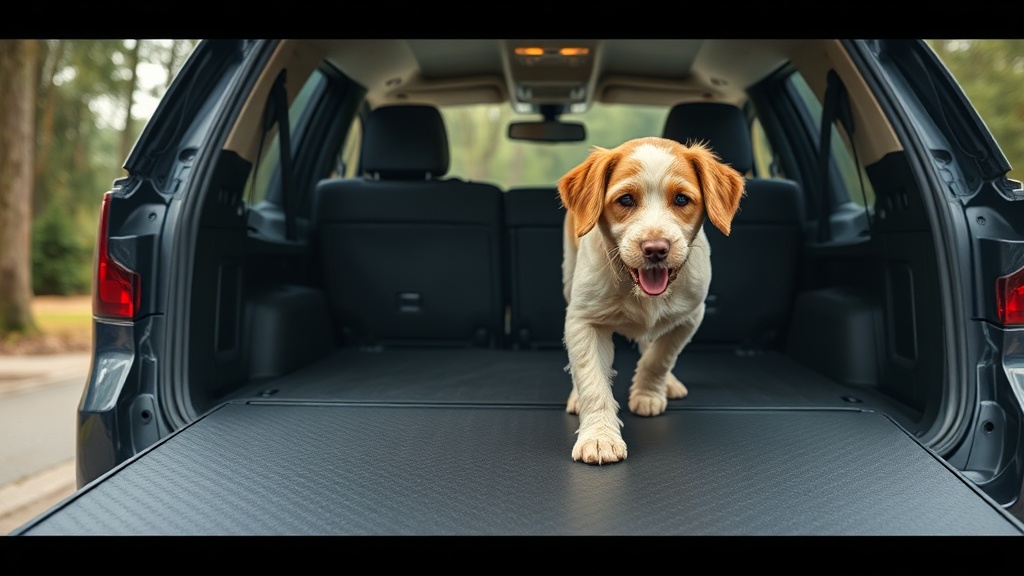
Dog Ramps for SUVs: Surface Grip Failures & Joint Impact
It’s a Saturday morning. Your 9-year-old Labrador is standing at the back of your SUV, back legs trembling, and you’re watching the ramp you spent $80 on slide sideways the moment his front paws hit it. He scrambles. His hips twist. He makes it in — but barely. And you’re left wondering whether that ramp just helped him or quietly made things worse. That scenario plays out in clinic parking lots and driveways more than most dog owners realize, and the mechanics behind it are exactly what I want to break down here: Dog Ramps for SUVs: Surface Grip Failures & Joint Impact.
I’ve worked through hundreds of mobility-related cases in a small animal clinic setting, and ramp failures show up in two categories — the dramatic ones where the dog slips visibly, and the slow ones where owners don’t connect chronic joint pain to daily microtrauma on a poorly designed ramp surface. Both matter. Both are preventable.
—
Why SUV Ramp Angles Change Everything
An SUV’s cargo height — typically 28 to 36 inches — forces a steeper ramp angle than most residential ramp products are designed to handle safely. That angle is the root of most grip-failure injuries.
Standard sedan rear bumper height sits around 18–22 inches. SUVs and trucks are a different world. When you place a 62-inch ramp against a 34-inch cargo floor, the incline approaches 30 degrees. At that slope, the physics of traction shift dramatically. Dogs rely on ground reaction forces pushing back through their paws; on a steep, slick surface, those forces redirect sideways and downward simultaneously, which places abnormal shear stress on the carpometacarpal joints in the front limbs and the stifle (knee) in the rear.
Small dogs under 20 pounds have a lower center of gravity and tend to recover slips more easily. Large and giant breeds — think Goldens, German Shepherds, Rottweilers, Great Danes — generate far more momentum on descent, which means a grip failure at the midpoint of a ramp isn’t a stumble, it’s a controlled fall. I’ve seen soft tissue injuries to the infraspinatus and supraspinatus muscles traced directly to repeated ramp slipping that the owner described as “minor.”
Surface Grip Failures: What’s Actually Going Wrong
Most grip failures aren’t random accidents — they follow predictable material and design patterns that vary by ramp brand, surface texture, and environmental conditions.
The pattern I keep seeing is owners choosing ramps based on weight capacity and fold-up convenience while ignoring surface coefficient of friction entirely. A ramp rated for 200 lbs means nothing if your dog’s paws are hydroplaning across a rubberized carpet backing in wet weather. Here’s what I see fail most often:
- Low-pile carpet surfaces: They feel grippy dry but compress under wet paws, turning into a near-frictionless channel. Common in budget-tier ramps under $60.
- Stamped rubber tread: Works well on flat terrain but the tread pattern channels mud and water downhill rather than dispersing it, especially at SUV angles above 25 degrees.
- Foam-core ramps with fabric coverings: The covering shifts during use, creating micro-wrinkles that destabilize paw placement mid-stride.
- Aluminum grate surfaces: Excellent grip when clean and dry. Become dangerous when wet, particularly for dogs with trimmed or worn paw pads.
- High-density sandpaper grip tape: Works for short-coated, healthy-pawed dogs, but abrades the digital pads of senior dogs with paw pad hyperkeratosis over weeks of daily use.
What surprised me was how many premium ramps fail in specific conditions their marketing never mentions. A ramp that grips beautifully in a heated garage performs completely differently on a cold, damp morning when your dog’s paws have morning dew from the grass. Material science doesn’t lie — the coefficient of friction for most rubberized surfaces drops 30–45% when wet.
Dog Ramps for SUVs: Surface Grip Failures & Joint Impact — The Clinical Connection
Repeated grip failures on ramp surfaces don’t just cause acute injuries — they create a cumulative joint-loading pattern that accelerates osteoarthritis progression in dogs already predisposed to musculoskeletal disease.
This is the part that most product reviews completely skip. A slip that doesn’t result in a fall still matters biomechanically. When a dog’s paw slides even an inch during weight-bearing, the stabilizing muscles around the stifle and hip fire in a reactive, uncoordinated pattern. Over time — and with daily vehicle loading and unloading — that reactive recruitment pattern leads to muscle fatigue, ligament microstress, and cartilage wear.
Dogs with hip dysplasia, elbow dysplasia, or intervertebral disc disease (IVDD) are at highest risk. For these patients, a ramp isn’t just a convenience — it’s a therapeutic device. And like any therapeutic device, a poorly fitted or malfunctioning one causes harm.
The ramp surface is a medical surface. Most owners don’t treat it that way — but they should.
I’ve also observed species-adjacent comparisons worth noting. Cats, when they use ramps (less common, but relevant in senior feline households), tolerate surface variability better due to their shock-absorbing spinal mechanics and lighter body mass. But dogs — especially those over 50 lbs — transmit significant force through their limbs with every ramp stride. The joint impact during a controlled descent on a 28-degree ramp can be equivalent to a low-impact trot on hard pavement. Multiply that by two entries and two exits per day, 365 days a year, and you’re looking at meaningful cumulative mechanical stress.
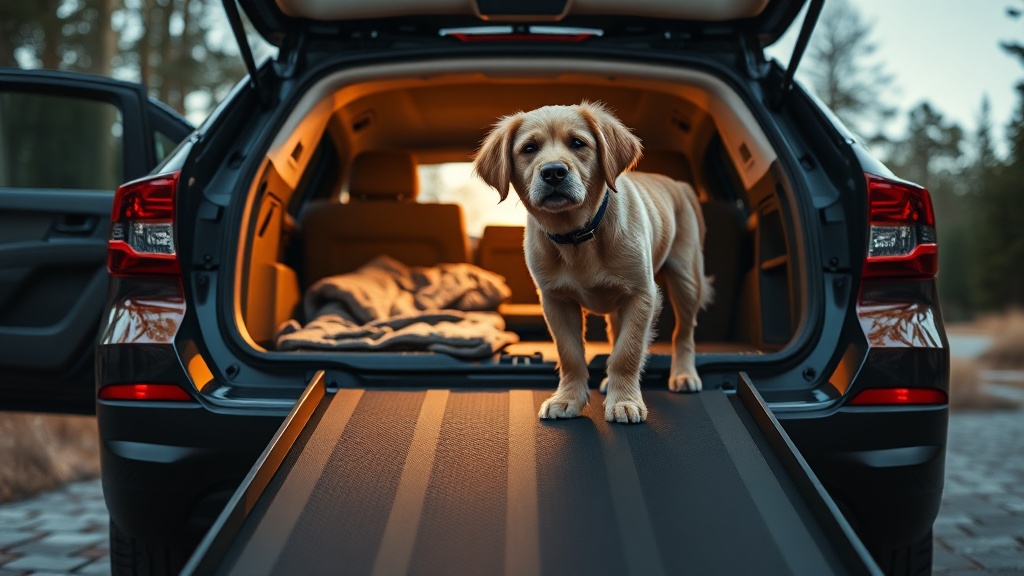
Signs to Watch For: Ramp-Related Joint Stress
Early signs of ramp-related joint loading are subtle and frequently misattributed to aging, making regular movement assessments critical for dogs who use vehicle ramps daily.
After looking at dozens of cases, these are the clinical signs I associate with ramp-related joint strain:
- Hesitation or refusal at the base of the ramp (pain anticipation behavior)
- Short-striding on one or both rear limbs after vehicle exits
- Stiffness for the first 10–15 minutes after loading/unloading
- Visible toe-drag on the ramp surface on descent
- Sudden sitting or stopping midway on the ramp
- Increased time to rise from a resting position on days with heavy vehicle travel
- Licking or chewing at the paws after ramp use (paw pad abrasion or sensitivity)
The clients who struggle with this are often those with high-activity dogs who didn’t show obvious mobility issues until their mid-to-late senior years. They attribute the stiffness to “just getting old.” Sometimes it is. But sometimes it’s cumulative microtrauma from three years of twice-daily grip failures they never identified as failures because the dog never visibly fell.
Choosing a Ramp That Actually Protects Joints
The best dog ramp for an SUV isn’t the one with the highest weight rating — it’s the one with the most consistent grip across real-world surface conditions and the most gradual achievable incline for your vehicle height.
The turning point is usually when owners stop shopping by price or storage convenience and start thinking about ramp geometry. Here’s what I recommend evaluating:
1. Length over angle. For a 34-inch cargo floor height, aim for a ramp of at least 72 inches. This brings your incline below 25 degrees, which significantly reduces the shear force on the stifle during descent. Yes, longer ramps are less convenient to store. That’s the tradeoff.
2. Surface texture verified wet AND dry. Before buying, look for independent reviews that specifically test the ramp surface in wet conditions. The American Kennel Club’s guidance on dog mobility aids emphasizes that traction under variable conditions is more important than maximum grip in a controlled environment.
3. Side rails matter more than most people think. Side rails at paw-level give dogs spatial feedback — they “feel” the edge of the ramp with their peripheral paw placement and self-correct their gait without visual reference. Without rails, dogs on steep ramps tend to overcorrect laterally, creating torque at the hip.
4. Weight capacity relative to your dog’s loaded body weight. A ramp rated exactly at your dog’s weight has no margin for dynamic loading. A 70-lb dog mid-stride generates peak forces above their static body weight. Rate at 1.5x minimum.
Most guides won’t tell you this, but: a dog ramp is only as good as the surface it’s deployed on. Even the best ramp will fail if placed on gravel, wet asphalt, or uneven ground. The base stability of the ramp’s feet matters as much as the traction surface. I’ve seen ramps with excellent grip panels fail catastrophically because their base feet slid on the garage floor when the dog’s momentum transferred downward during descent.
Unpopular opinion: for most large-breed dogs with existing joint disease, a high-quality telescoping ramp with a 72-inch+ reach will outperform a set of carpeted steps every single time — even though steps are more commonly recommended for space-saving. Steps require a hopping motion that’s mechanically harder on dysplastic hips than a continuous-stride ramp ascent. The step-to-step clearance forces each rear limb to load fully before the next stride, amplifying impact forces at the point of disease.
When to See a Vet Instead
If your dog shows any of the following, this isn’t a ramp adjustment issue — it’s a veterinary one: sudden unwillingness to bear weight on any limb after a ramp slip, crying or vocalizing during ramp use, visible swelling around the carpus or stifle, or any acute change in gait. These signs may indicate ligament tears, joint effusion, or disc events that require imaging and intervention, not ramp upgrades.
—
Ramp Comparison Summary
Here is a summary of everything we covered about ramp surface types, their failure conditions, and their suitability for senior or joint-compromised dogs.
| Surface Type | Grip (Dry) | Grip (Wet) | Pad Safety | Recommended For |
|---|---|---|---|---|
| Low-pile carpet | Moderate | Poor | Good | Dry-climate, indoor-use only |
| Stamped rubber tread | Good | Fair | Good | General use, flat terrain base |
| Aluminum grate | Excellent | Poor | Moderate | Dry climates, healthy pads only |
| Sandpaper grip tape | Excellent | Good | Poor (long-term) | Short-term, young dogs, short coats |
| High-traction rubber mat (poured) | Excellent | Excellent | Excellent | Senior dogs, joint disease, all climates |
| Foam-core fabric cover | Fair | Poor | Good | Not recommended for SUV use |
—
FAQ
How do I know if my dog’s ramp angle is too steep for their joint health?
A practical field test: if your dog shortens their stride noticeably on descent, braces their front legs at the base, or pauses mid-ramp, the angle is likely too steep. Measure your cargo floor height and divide by the ramp length to calculate the sine of the incline angle. Anything above 25 degrees (approximately a 0.42 rise-to-run ratio) warrants a longer ramp for dogs with existing joint conditions.
Can I add grip tape to an existing ramp to fix surface failures?
You can, but with caveats. Coarse sandpaper tape (60–80 grit equivalent) provides excellent short-term grip but will abrade digital pads within weeks of daily use, particularly in senior dogs with thinner pad skin. A better option is applying peel-and-stick high-traction rubber sheeting, which provides grip without abrasion. Ensure the adhesive bond is complete — partially adhered tape creates edge catches that can snag nails.
Are ramps or stairs better for dogs with hip dysplasia?
For hip dysplasia specifically, ramps are almost universally preferred over stairs. Stairs require the rear limbs to generate vertical propulsion force from a partially flexed position, which loads the hip joint at its mechanically weakest angle. A ramp allows a continuous gait pattern that distributes force more evenly across the stride cycle. The critical variable is ramp length — a 72-inch or longer ramp at SUV height keeps the angle manageable for dysplastic dogs.
—
The insight that changes how you shop for a ramp: you’re not buying a convenience product. You’re buying a therapeutic load-management device for a joint system that will either degrade slowly or hold up depending on the quality of equipment you choose. Every slip on that surface is a biomechanical event. The dogs who age well with their ramps aren’t luckier — they have owners who understood the physics before the injury happened.
—
References
- American Kennel Club. “Dog Ramps and Stairs: Helping Your Dog Get Around.” https://www.akc.org/expert-advice/health/dog-ramps-stairs/
- Veterinary Evidence Journal. Canine Osteoarthritis Management Working Group. Clinical guidelines for the management of canine osteoarthritis. 2022.
- Dycus DL, Levine D, Marcellin-Little DJ. Physical rehabilitation for the management of canine hip dysplasia. Veterinary Clinics of North America: Small Animal Practice. 2017.
- Millis DL, Drum M, Levine D. Therapeutic exercises: early limb use exercises. Canine Rehabilitation and Physical Therapy. 2nd ed. Elsevier. 2014.
- Troncy E, et al. Correlation between kinetic data and clinical mobility assessment scores in dogs with hip dysplasia. American Journal of Veterinary Research. 2019.