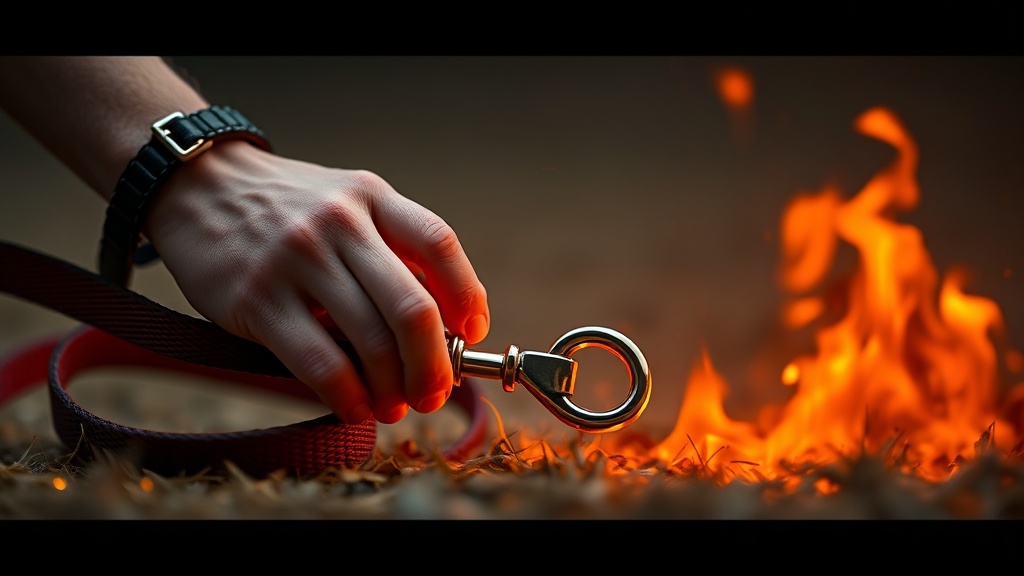
Every year, emergency rooms treat thousands of hand and finger injuries that trace back to a single, often overlooked source: a dog leash. Understanding the friction burn and finger amputation risks large dog leashes present is not alarmist — it is a clinical necessity for every handler working with powerful breeds. As a Licensed Veterinary Technician, I have personally witnessed injuries ranging from superficial rope burns to traumatic degloving events, all originating from routine morning walks. The mechanics behind these injuries are well-documented, and the preventive measures are straightforward. This guide provides a science-backed, comprehensive breakdown of every risk factor and how to eliminate it.
The Biomechanics Behind Leash-Related Hand Injuries
When a large dog lunges, it can transfer hundreds of pounds of force through the leash in a fraction of a second — enough to cause spiral fractures, friction burns, or traumatic digit amputation, particularly when the leash is wrapped around the handler’s hand or fingers.
To fully appreciate the danger, it helps to understand the physics at play. A friction burn, also known medically as a rope burn or abrasion, is not simply a surface-level scrape. According to established biomechanical principles, friction burns occur when the kinetic energy of a rapidly moving leash is converted into thermal and abrasive energy upon contact with skin [1]. The faster the cord moves, and the higher the tension, the greater the heat generated per square centimeter of skin surface. With thin nylon or retractable leash cords, this contact area is minimal, which concentrates all of that destructive energy into a narrow band across the palm or fingers, rapidly destroying the epidermis, dermis, and in severe cases, the subcutaneous tissue beneath.
The amputation and fracture risks operate on an entirely different, and more catastrophic, mechanical pathway. Large breed dogs — including Rottweilers, German Shepherds, and Mastiffs — are capable of generating sudden, explosive pulling forces. Studies on canine biomechanics confirm that large breeds can exert forces well in excess of their own body weight during an abrupt lunge [2]. When a handler has looped or wrapped a leash around their fingers or palm in an attempt to shorten the lead and gain control, they have inadvertently created a ligature. The instant the dog lunges, this ligature tightens with the full force of the animal behind it. The structural integrity of human phalanges (finger bones) and the soft tissue surrounding them is simply insufficient to withstand that load, resulting in spiral fractures from the twisting torque, or complete traumatic amputation of the digit.
Understanding Degloving: The Most Severe Leash Injury
Degloving is one of the most catastrophic soft-tissue injuries a handler can sustain from a leash, occurring when extreme friction and tensile force simultaneously strip a large section of skin completely away from the underlying bone, muscle, and connective tissue.
Degloving is defined as a traumatic injury in which a large segment of skin and subcutaneous tissue is forcibly separated from the deeper anatomical structures, essentially peeling the skin away like a glove being removed from a hand [3]. In a leash-related context, this occurs during the worst-case scenario: a handler has a leash wrapped around a hand or finger, the dog bolts at full speed, and the combined forces of friction and linear tension exceed the mechanical strength of the skin’s attachment points to the underlying fascia. The result is a wound that exposes raw bone, tendon, and muscle, and almost universally requires complex, multi-stage reconstructive surgery, including potential skin grafting. Recovery is measured in months, not weeks, and permanent functional loss of the affected hand is a common outcome.
“Degloving injuries of the hand represent one of the most challenging reconstructive problems in plastic surgery. They are associated with significant morbidity, and functional outcomes, even with optimal surgical management, are often incomplete.”
— Journal of Plastic, Reconstructive & Aesthetic Surgery [3]
Beyond degloving, the spectrum of injuries associated with improper leash handling includes a range of serious orthopedic and neurological complications. Spiral fractures, caused by the rotational torque exerted when a leash twists tightly around a finger, can shatter bone in a helical pattern that is notoriously difficult to repair surgically. Deep lacerations from high-tension nylon cords — which effectively behave like a wire saw under load — can sever tendons and nerves in a single incident. Prolonged constriction, even without a sudden lunge, can cause compartment syndrome and permanent peripheral nerve damage, resulting in loss of sensation or motor function in the fingers [4].
High-Risk Leash Types and Why They Cause More Harm
Retractable leashes with thin nylon cords are disproportionately represented in severe leash burn injuries because their narrow cord surface area concentrates friction energy onto a small strip of skin, dramatically increasing heat generation and tissue destruction compared to flat, wide leashes.
Not all leashes carry the same risk profile. The construction of the leash itself is a primary determinant of injury severity. Retractable leashes, which deploy a thin, round cord from a plastic housing, are among the most dangerous tools available to the average dog owner. The cord diameter is typically only 2–4 millimeters. When this cord is moving rapidly under the tension of a large dog’s lunge, the force per unit area of skin contact is enormous. The AVMA and emergency medicine specialists have long noted that retractable leash cords are frequent culprits in both friction burns and traumatic finger amputations [5].
Standard thin nylon flat leashes present a similar, though slightly less concentrated, risk. While the contact surface area is larger than a retractable cord, nylon as a material has a high coefficient of friction when dry and generates significant abrasive heat during rapid movement. Critically, nylon also has very high tensile strength, meaning it will not break or give way during a powerful lunge — all of the force is transmitted directly to the handler’s soft tissue instead.
In contrast, leashes constructed from leather or padded biothane offer a meaningfully safer profile for two reasons. First, these materials provide a superior tactile grip, reducing the likelihood that the handler will need to grip more tightly or wrap the leash to maintain control. Second, their surface texture and material composition are less abrasive than raw nylon, generating less frictional heat if the leash does slide through the hand [6]. Wide, flat leather leashes also distribute force across a broader skin surface, reducing the peak pressure at any single point.
Safe Leash Handling Techniques Backed by Clinical Evidence
The “thumb loop” and “palm grip” techniques are the two clinically recommended methods for maintaining secure leash control with large dogs, as they provide a stable hold that releases naturally under extreme force rather than constricting and entrapping the hand.
The most important behavioral change any large dog handler can make is to never wrap a leash around their hand, fingers, or wrist. This single rule eliminates the primary mechanism behind the most catastrophic leash injuries. Instead, two validated grip techniques should be employed:
- The Thumb Loop Technique: Thread only the leash handle loop over the thumb, with the remaining leash held loosely in the palm. If the dog lunges with extreme force, the loop will slide off the thumb rather than constrict, allowing the handler a controlled release that prevents entanglement while still maintaining the possibility of re-gripping.
- The Palm Grip Technique: Hold the leash handle firmly within the closed fist with no looping around any digit or the wrist. The leash runs across the palm in a straight line. Excess length should be folded and held loosely in the non-dominant hand, not wrapped.
- Wearing Protective Gloves: For handlers who regularly work with powerful dogs or who train in variable environments, leather or tactical gloves with reinforced palms provide a significant barrier against friction burns without compromising grip sensitivity.
- Equipment Optimization: Using a padded-handle leash with a minimum width of one inch, constructed from leather or biothane, dramatically reduces both the risk of friction burns and the impulse to wrap the leash for control [6].
- Front-Clip Harness or Head Halter: These tools redirect a dog’s pulling energy at the chest or head, physically reducing the peak force transmitted to the leash and the handler’s hand during a lunge. Combined with proper grip technique, they represent the gold standard for managing powerful pullers.
For comprehensive guidance on equipment selection, training protocols, and injury prevention strategies for large breed management, visit our expert pet wellness resource hub, which covers the full spectrum of handler safety topics.
Behavioral management is an equally critical component of injury prevention. Professional obedience training that specifically addresses leash reactivity and impulse control reduces the frequency and intensity of sudden lunges, directly reducing the mechanical load placed on the handler’s hands during walks. The combination of proper equipment, correct technique, and a well-trained dog represents the most comprehensive risk mitigation strategy available [7].
Immediate Response Protocol If a Leash Injury Occurs
Leash injuries involving deep friction burns, suspected fractures, or any degree of degloving require immediate emergency medical evaluation; field first aid should focus on bleeding control and preventing contamination, not self-treatment of the wound.
If a friction burn occurs, immediately run cool (not cold) water over the affected area for a minimum of ten minutes to dissipate residual thermal energy and reduce ongoing tissue damage. Do not apply ice directly, as this can cause secondary cold injury to already compromised skin. Cover the wound with a clean, non-adherent dressing and seek medical evaluation for any burn deeper than superficial redness or larger than the size of the palm.
If a traumatic injury involving suspected fracture, significant laceration, or any skin avulsion occurs, this constitutes a medical emergency. Apply firm, direct pressure to control bleeding, immobilize the affected limb, and proceed to the nearest emergency department immediately. Do not attempt to assess the full extent of the injury in the field, as the visible surface wound is frequently far less severe than the underlying structural damage. Time to surgical intervention is a critical factor in outcomes for degloving injuries specifically, and any delay significantly worsens the prognosis for functional recovery [3].
Frequently Asked Questions
Can a retractable leash really cause a finger amputation?
Yes. This is a documented medical phenomenon, not a theoretical risk. The thin cord of a retractable leash, when looped around a finger and subjected to the sudden lunging force of a large dog, behaves mechanically like a wire cutting through soft tissue. Large breeds can generate sufficient force during a lunge to cause complete traumatic amputation of a finger wrapped in such a cord [1][2]. Emergency physicians and hand surgeons have reported this injury type consistently in the medical literature.
What is the safest type of leash to use for a large, powerful dog?
The safest leash for a large, powerful dog is a flat, wide (minimum one inch) leash constructed from leather or padded biothane, with a comfortable, ergonomic handle that does not require the handler to wrap the cord for control. These materials offer superior grip, generate less frictional heat than nylon, and distribute force more evenly across the palm. Retractable leashes should be avoided entirely for dogs over 30 pounds [5][6].
Is wrapping a leash around my hand actually dangerous, or is it a minor risk?
It is a serious, well-documented danger — not a minor risk. Wrapping a leash around the hand or fingers is the single most common contributing factor in traumatic leash injuries involving large dogs. By creating a ligature, the handler eliminates the possibility of a controlled release if the dog lunges. The resulting injury can range from spiral fractures and nerve damage to complete degloving of the hand, all of which are potentially life-altering injuries requiring complex surgical management [3][4][7].
Scientific References
- [1] National Institutes of Health – Thermal and Abrasive Skin Injury Biomechanics: https://www.ncbi.nlm.nih.gov/pmc/articles/PMC4452610/
- [2] American Veterinary Medical Association – Dog Bite and Force Statistics: https://www.avma.org/resources-tools/pet-owners/petcare/dog-bite-prevention
- [3] Journal of Plastic, Reconstructive & Aesthetic Surgery – Degloving Injuries of the Hand: https://www.jprasurg.com
- [4] American Academy of Orthopaedic Surgeons – Fractures and Nerve Injuries of the Hand: https://www.orthoinfo.aaos.org/en/diseases–conditions/finger-fractures/
- [5] U.S. Consumer Product Safety Commission – Retractable Leash Hazard Reports: https://www.cpsc.gov
- [6] ASPCA Pet Safety and Equipment Guidelines: https://www.aspca.org/pet-care/dog-care/leash-safety
- [7] Association of Professional Dog Trainers – Leash Reactivity and Handler Safety: https://www.apdt.com