
Dog Winter Coat Restricting Hind Leg Movement in Arthritic Dogs: What I Wish I’d Known Sooner
I used to recommend winter coats to almost every senior dog owner who walked into our clinic. Blanket recommendation, no hesitation. Then I started noticing something in our follow-up appointments that quietly changed how I practice: dogs with hip and lumbar arthritis were coming back with increased stiffness, more reluctance to go up stairs, and owners confused about why their dog seemed worse despite doing everything right. The coats were staying on all day. And more than once, dog winter coat restricting hind leg movement in arthritic dogs was the exact phrase that finally helped an owner understand what we were dealing with. I don’t make blanket coat recommendations anymore. Here’s why.
Why Cold Weather Already Puts Arthritic Dogs at a Disadvantage
Cold temperatures cause synovial fluid in joints to thicken, reducing its lubricating effectiveness and making movement more painful for arthritic dogs — this is especially pronounced in the hips, stifles, and lumbosacral junction of senior dogs.
Arthritis — formally osteoarthritis or degenerative joint disease — affects an estimated 20% of adult dogs over one year of age, with prevalence climbing sharply in dogs over seven. Cold weather compounds the problem on a physiological level. Synovial fluid viscosity increases in lower temperatures, joint capsules tighten, and peripheral circulation decreases, which delays the delivery of inflammatory mediators away from affected joints. Dogs don’t vocalize pain the way humans do, so owners often interpret reduced movement in winter as laziness rather than discomfort. The pattern I keep seeing is that owners invest in coats and boots expecting a dramatic improvement, not realizing the coat itself can introduce a secondary mechanical problem.
Cats experience similar cold-weather joint changes, but their arthritis is historically underdiagnosed because of their stoic behavior and tendency to rest more, so their guardians rarely reach for jackets the way dog owners do. Dogs are more visible in their winter struggle.
The hind limbs carry the brunt of arthritic disease in most breeds. The hip joints, stifles (knees), and intervertebral spaces from L4 through S1 are the most commonly affected regions in canine degenerative joint disease. Any restriction around those areas matters.
Cold isn’t the enemy — unmanaged cold combined with restricted movement is.
How a Dog Winter Coat Can Restrict Hind Leg Movement
Many standard dog coats are designed for a generalized fit that prioritizes torso coverage, often cutting across the femoral region or pulling tight over the hindquarters — directly limiting the range of motion arthritic dogs depend on.
Here’s the mechanical reality. Most off-the-shelf dog coats are cut to cover the back and belly, with leg openings positioned for an average gait in a healthy dog. When you put that same coat on an arthritic dog with hip dysplasia or lumbosacral stenosis, several problems emerge. The coat fabric pulls taut when the dog extends the hind limbs forward during a normal stride. If the dog already has reduced range of motion, that extra resistance — even a small amount from a snug-fitting coat — creates compensatory gait changes. The dog shortens its stride. It loads the forelimbs more. It may start toe-dragging on the affected side.
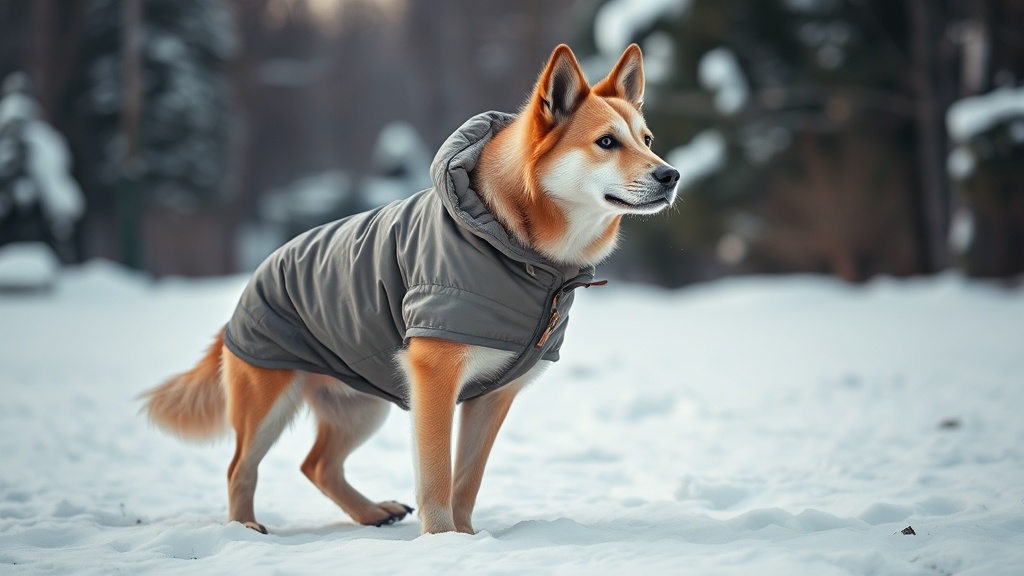
What surprised me was how quickly this happens. In some cases, a coat worn for just a few hours over several consecutive days was enough to shift a dog’s compensatory posture measurably. The topline muscles begin to brace, the lumbar region tightens, and you get a feedback loop of pain causing guarding causing more pain.
Key Insight: “A coat that keeps an arthritic dog warm but alters their gait is not a net win. Warmth gained from restricted movement can accelerate joint degeneration faster than cold weather alone.”
Breeds most at risk include German Shepherds, Labrador Retrievers, Golden Retrievers, Rottweilers, and Dachshunds — all with high rates of hip dysplasia or intervertebral disc disease. In contrast, smaller breeds like Chihuahuas and Miniature Pinschers actually need coats more urgently due to low body fat, but their arthritis tends to present in the elbows and patellas rather than the hips, making coat fit a different conversation.
The turning point is usually when an owner watches a slow-motion video of their dog walking in a coat versus without. The stride difference is visible in seconds.
Signs Your Dog’s Coat Is Making Their Arthritis Worse
Behavioral and physical signs of coat-related movement restriction can mimic a general arthritis flare — making it easy to miss the coat as a causative factor without careful observation.
I’ve seen this go wrong when owners increase pain medication doses because they assume the dog is having a cold-weather flare, not realizing the coat is the variable that changed. Watching for specific signs tied to coat use is the more precise diagnostic step. Look for a change in gait that occurs specifically during and after wearing the coat, not generally throughout the day. A dog who moves freely before the coat goes on but shortens stride or bunny-hops after is showing you a direct correlation.
Signs to watch for:
- Reluctance to move normally within 10–15 minutes of the coat being applied
- Bunny-hopping gait (both hind legs moving together) rather than alternating stride
- Toe-dragging or scuffing the rear nails on pavement
- Increased lumbar rounding or “roach back” posture while wearing the coat
- Vocalization or turning to look at the hindquarters when the coat is put on
- Greater hesitation at stairs or curbs specifically after coat application
The clients who struggle with this are usually the most dedicated owners — the ones who are already doing everything else right. They’re giving the joint supplements, managing body weight, doing the short leash walks. The coat seems like a logical next step. And it can be, if you get the fit right.
When to see a vet instead: If your dog shows sudden hind limb weakness, knuckling over, or inability to rise that is not resolved within a few hours of removing the coat, this may indicate neurological involvement — a veterinary emergency that goes beyond arthritis management.
How to Choose a Winter Coat That Doesn’t Compromise Hind Leg Function
Fit criteria for arthritic dogs prioritize unrestricted femoral extension, adjustable leg openings, and lightweight materials — the opposite of what many “heavy-duty” winter coats offer.
After looking at dozens of cases, the coat characteristics that consistently protect hind leg function share a few features. First, the hem should stop before or at the base of the tail, not extending down over the hindquarters. Second, leg openings must be generous — not a snug ring of fabric but a relaxed, flexible opening that does not contact the inner thigh during stride. Third, the material itself matters: fleece and soft-shell fabrics stretch with the dog’s movement, while rigid quilted or shell materials do not. Fourth, avoid coats with belly straps that cinch under the abdomen just in front of the rear legs — these directly limit pelvic flexion.
Look for coats specifically labeled for mobility or senior dogs. Some manufacturers design them with ergonomic rear cuts, though marketing language varies. VCA Animal Hospitals’ arthritis resource for dogs outlines the musculoskeletal considerations that should guide any physical management decision for arthritic pets — it’s worth bookmarking for any senior dog owner.
Most people get stuck assuming that more coverage equals more warmth equals better outcomes. But a lightweight fleece vest that covers the thorax and keeps core temperature stable — without touching the hindquarters — often does more measurable good than a full-body insulated coat that locks up the dog’s rear end.
Fit the coat to the dog’s current range of motion, not the range you wish they had.
Supporting Arthritic Dogs in Winter Beyond the Coat
Cold-weather arthritis management is multi-modal — coat selection is one piece of a larger protocol that includes joint supplementation, surface management, controlled exercise, and veterinary pain management review.
The coat question almost always comes up inside a bigger conversation about winter arthritis flares, and I find it’s more productive to address the full picture. The AKC Canine Health Foundation’s arthritis management overview is a reliable reference that covers pain protocol adjustments for seasonal changes — something I discuss with owners every October before the cold sets in.
Surface management is underrated. Cold, hard floors cause arthritic dogs to tense their hind limbs constantly, and this low-grade muscle guarding is exhausting over a full day. Orthopedic mats at resting spots, non-slip runners on tile or hardwood, and ramps to replace stairs all reduce the cumulative joint load before the dog ever steps outside.
For nutrition, omega-3 fatty acids (specifically EPA and DHA from marine sources) have the strongest evidence base for joint inflammation reduction in dogs. I always review the dog’s current food and supplement stack before recommending coat changes, because sometimes a diet already high in inflammatory ingredients is a bigger problem than the cold itself. If you want to explore how nutrition intersects with mobility for aging dogs, our expert pet wellness resources cover this in depth.
Unpopular opinion: short, frequent walks in cold weather without a coat are often better for an arthritic dog’s long-term joint health than longer walks in a poorly fitting coat. Movement — even cold-weather movement — pumps synovial fluid through the joint and maintains muscle mass that supports arthritic joints. A coat that shortens stride or alters gait defeats the purpose of the walk entirely. I’d rather see a dog do three five-minute leash walks in a light fleece vest than one twenty-minute walk locked into a full-body coat that changes how they move.
Every tool in the arthritis management toolkit works only as well as its fit to the individual patient — coats included.
Frequently Asked Questions
Can a dog winter coat actually make arthritis worse, or just fail to help?
Yes, it can actively worsen symptoms in some dogs. A coat that restricts hind leg extension forces compensatory gait changes — shorter stride, increased forelimb loading, lumbar bracing — which create new mechanical stress on already compromised joints. This is not a theoretical risk; it is something I have observed clinically across multiple patients with hip and lumbosacral arthritis.
How do I measure my arthritic dog for a coat that won’t restrict movement?
Measure back length from the base of the neck to the base of the tail — the coat should not extend past this point over the hindquarters. Measure girth at the widest point of the chest and around the abdomen. Then watch the dog walk in the coat before purchase or before committing to a brand: the hind leg stride should not shorten, and the hips should move freely without visible pulling from the fabric.
Are heated dog coats or blankets safer for arthritic dogs than standard insulated coats?
Heated blankets used at rest are generally safer than heated wearable coats because they provide warmth without any mobility restriction. For active use, a lightweight fleece vest — not a full-body heated garment — is usually the better compromise. Always verify that any heated product is designed for pets and has automatic thermal shutoffs; burns from overheating products are a real clinical concern in senior dogs with reduced sensory perception in the skin.
References
- VCA Animal Hospitals. “Arthritis in Dogs.” https://vcahospitals.com/know-your-pet/arthritis-in-dogs
- AKC Canine Health Foundation. “Managing Arthritis in Dogs.” https://www.akcchf.org/canine-health/your-dogs-health/caring-for-your-dog/managing-arthritis-in-dogs.html
- Koehler, R., DVM. “Dog Arthritis and Cold Weather: Helping Your Dog’s Arthritis Pain in Winter.” Taste of the Wild Pet Food.
- Johnston, S.A. “Osteoarthritis: Joint anatomy, physiology, and pathobiology.” Veterinary Clinics of North America: Small Animal Practice. 1997.