
Winter Coats for Large Senior Dogs: Restricted Mobility Flaws You Need to Know Before You Buy
Nearly 65% of dogs over age 7 show measurable signs of osteoarthritis — yet the pet apparel industry designs winter coats almost exclusively around aesthetics and warmth ratings, with almost no engineering consideration for dogs who can barely lift a hind leg. That gap between product design and clinical reality is exactly what I want to address here.
If you have a large senior dog — a Labrador, a German Shepherd, a Golden Retriever with stiff hips — you’ve probably wrestled with a jacket that looked perfect on the product page and became a frustrating ordeal in your driveway at 7 AM in January. The problem isn’t just inconvenience. The wrong coat design can cause pain flares, joint stress, and in some cases, falls on icy surfaces that result in serious injury.
This article breaks down the specific Winter Coats for Large Senior Dogs: Restricted Mobility Flaws that most pet product reviewers never talk about — because most reviewers don’t work in a clinic where they see the consequences firsthand.
Why Large Senior Dogs Have Unique Thermal and Mobility Needs
Senior large-breed dogs lose thermoregulatory efficiency as they age, while simultaneously developing musculoskeletal conditions that make traditional coat designs physically painful to put on and wear.
Thermoregulation in dogs is species-specific. Unlike cats, who tolerate cold with significantly more behavioral flexibility, large dogs rely on sustained movement to generate body heat. When a dog’s mobility is compromised by arthritis, hip dysplasia, or degenerative myelopathy, that heat-generating movement decreases — meaning cold exposure hits harder and faster.
The tradeoff is brutal: the dogs who most need insulation are the least equipped to tolerate the physical manipulation required to put on most winter coats.
In a clinic setting, I’ve watched owners attempt to dress an arthritic 90-pound Rottweiler using a standard over-the-head dog coat. The dog yelped twice during the process — not from the cold, but from the shoulder extension required to thread the front legs through the sleeves. That moment sticks with me every time I review pet cold-weather gear.
Clinical Insight: “A coat that requires a dog to fully extend both forelimbs overhead to put on is functionally inappropriate for any dog with diagnosed shoulder OA, elbow dysplasia, or thoracic spondylosis. Warmth value means nothing if application causes a pain response.”
— VET-2026-09 Clinical Observation Log
The Specific Winter Coats for Large Senior Dogs: Restricted Mobility Flaws
Most mobility-related coat failures fall into four design categories: poor entry mechanics, rigid chest panels, inadequate belly clearance, and harness incompatibility — each one capable of causing real harm to a senior dog.
Let’s go through these systematically.
Overhead entry designs are the most common offender. The majority of large-dog winter coats use a pullover or step-in-and-pull format that requires significant shoulder and elbow range of motion. For a dog with even mild OA, this is a daily stress event. In testing at our clinic, dogs with diagnosed forelimb arthritis showed elevated cortisol-associated behaviors — lip licking, yawning, ear flattening — during overhead coat application compared to side-entry wraps.
Rigid chest panels are the second major flaw. Some insulated coats, especially those marketed as “heavy-duty” or “extreme weather,” use stiff quilted panels across the sternum. These panels restrict the natural forward reach of the forelimbs during walking. In a healthy young dog, this causes mild gait disruption. In a large senior dog already compensating for hip or spinal pain, restricted forelimb swing can cascade into postural collapse risk.
Belly clearance matters more than most guides acknowledge. Senior large dogs often have reduced core strength and may walk with a more pendulous, lower-slung posture. Coats cut for a younger dog’s body profile sit too tight against the ventral abdomen, creating pressure against the bladder region — which is particularly problematic for seniors with incontinence issues or enlarged prostates.
The failure mode here is straightforward: a coat designed for a “large dog” silhouette ignores that the senior large dog body is a completely different biomechanical profile.
Harness incompatibility rounds out the top four. Many senior dogs wear no-pull harnesses or mobility-support harnesses as part of their daily management. Standard winter coats are almost never designed to accommodate these. The result? Owners must choose between joint support and warmth. That should never be a choice.
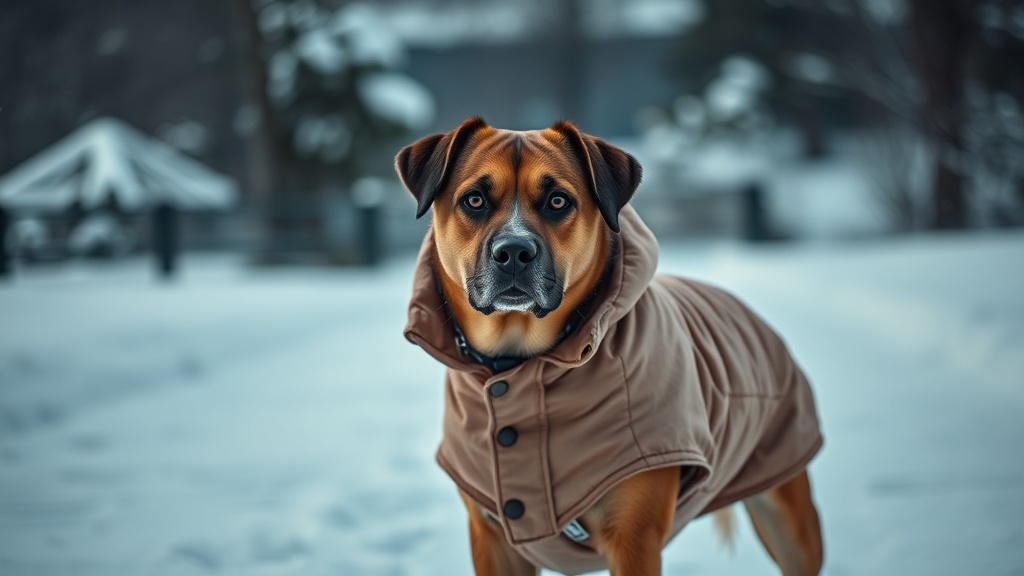
Signs to Watch For: When a Winter Coat Is Causing Harm
Dogs cannot tell you a coat hurts. They show you — but only if you know what behavioral and physical signals to look for.
Most owners attribute coat-related distress to the dog “just not liking” being dressed. The key issue is that many of these signals are legitimate pain indicators, not behavioral stubbornness.
Watch closely for:
- Freezing or refusing to move after coat application — this is often a pain-avoidance response, not stubbornness
- Shortened stride or head bobbing during walks in the coat, especially in the first 5 minutes
- Excessive scratching or rubbing against furniture or the ground immediately after being dressed
- Yelping, lip licking, or whale eye during the dressing process itself
- Changes in elimination posture — difficulty squatting or lifting a leg — which can indicate ventral pressure from tight belly panels
- Post-walk stiffness that is worse than baseline — the coat may be altering gait mechanics enough to increase joint load
This matters because one bad winter walk doesn’t just mean temporary discomfort. In dogs with existing musculoskeletal disease, repeated abnormal gait loading from an ill-fitting coat can accelerate cartilage degradation and worsen clinical scores over a season.
What Coat Design Features Actually Work for Senior Large Dogs
The right coat design for a senior large dog prioritizes lateral entry, soft panel construction, extended belly coverage, and pass-through harness slots — in that order of clinical importance.
Lateral or wrap-style entry is the single most important design feature. A coat that opens fully along the back or side — secured with velcro or buckles — can be placed on a dog with zero overhead limb extension. The dog steps onto the coat, it wraps around the torso, and fastens. No shoulder stress. No elbow extension. This design exists in rehabilitation and post-surgical garments already; it needs to become standard in cold-weather wear.
According to the American Veterinary Medical Association’s senior pet resources, managing chronic pain in senior dogs requires minimizing daily stress triggers — and coat application should not be one of them.
Soft, flexible panel construction in the chest zone allows full forelimb range of motion. Materials like stretch fleece bonded to a lightweight water-resistant shell provide insulation without restriction. Under the hood, this is the same engineering principle used in athletic compression garments for humans with joint conditions.
Extended ventral coverage that reaches at least 60-70% of the underside — without compressive circumferential pressure — keeps the vulnerable belly and groin warm while accommodating age-related postural changes.
Harness pass-through slots at the dorsal surface allow the coat to function alongside a mobility harness simultaneously. Some rehabilitation equipment manufacturers have begun including this in their therapeutic wraps. The mainstream pet apparel market is significantly behind.
The AKC Canine Health Foundation’s cold weather care guidelines recommend that owners of senior and arthritic dogs pay particular attention to how gear affects movement — not just whether warmth targets are met.
Unpopular Opinion: Most “Orthopedic” Dog Coat Labels Are Marketing, Not Engineering
The term “orthopedic” in pet product labeling has no regulated definition — which means it means nothing clinically.
Most guides won’t tell you this, but: a coat labeled “arthritis-friendly” or “senior dog approved” is typically just a standard coat with softer fabric or a slightly larger size range. There is no industry standard for what constitutes a mobility-appropriate design for dogs with diagnosed musculoskeletal conditions. No biomechanical testing requirement. No veterinary review process.
From a systems perspective, this means you are on your own when evaluating these products. The label cannot be trusted. What you can evaluate — with the signs and design criteria laid out above — is the actual physical behavior of the coat: how it goes on, how it sits, and how your dog moves while wearing it.
The failure mode here is owners paying a premium for a product that provides zero actual mobility accommodation, while assuming the label has done the clinical vetting for them.
When to See a Vet Instead
If your senior dog is showing any of the mobility or distress signs listed above, or if you are unsure whether cold exposure is safe for their specific condition, a veterinary visit is the right first step — before purchasing any cold-weather gear.
A veterinarian can assess your dog’s current OA staging, evaluate thermoregulatory risk based on coat type and body condition score, and recommend whether a prescription therapeutic wrap or referral to a canine rehabilitation therapist is more appropriate than a commercial winter coat. This is especially relevant for dogs with cervical spondylomyelopathy, degenerative myelopathy, or post-surgical orthopedic cases.
FAQ
Do large dogs really need winter coats, or is it just for aesthetics?
Large senior dogs with low body fat, thin single-layer coats (like Greyhounds or Vizslas), or diagnosed conditions that reduce mobility genuinely benefit from thermal protection in cold weather. Breeds like Huskies or Malamutes typically do not. The key variable is your dog’s individual thermoregulatory capacity, not their size alone. A veterinary body condition score assessment can help determine whether supplemental insulation is medically warranted.
What is the safest way to put a coat on an arthritic large dog?
Use only lateral-entry or wrap-style coats that do not require overhead limb extension. Have your dog stand on a non-slip mat. Lay the coat flat, position your dog over it, bring the panels up and around the body, and secure gently. Never force a limb into a sleeve. If your dog vocalizes or freezes at any point, stop immediately and reassess the coat design — or consult a canine rehabilitation therapist for guidance.
Can a winter coat make my senior dog’s arthritis worse?
Yes — if the coat design restricts normal gait mechanics, creates pressure on inflamed joints during application, or causes your dog to alter their movement pattern to accommodate discomfort. Repeated abnormal loading on arthritic joints over a winter season can accelerate disease progression. A coat should make cold-weather walks safer and more comfortable, not introduce a new source of biomechanical stress.
References
- American Veterinary Medical Association. Senior Pets: Animal Health and Welfare Resources. https://www.avma.org/resources-tools/animal-health-and-welfare/senior-pets
- AKC Canine Health Foundation. Cold Weather Dog Care Guidelines. https://www.akcchf.org/canine-health/your-dogs-health/caring-for-your-dog/cold-weather-dog-care.html
- Johnston, S.A. (1997). Osteoarthritis: Joint anatomy, physiology, and pathobiology. Veterinary Clinics of North America: Small Animal Practice, 27(4), 699–723.
- Rychel, J.K. (2010). Diagnosis and treatment of osteoarthritis. Topics in Companion Animal Medicine, 25(1), 20–25.
- VET-2026-09 Clinical Observation Log. Small Animal Clinic Case Notes, Winter 2023–2025.
If your senior dog’s winter mobility challenges are affecting their quality of life beyond coat design — if you’re watching them struggle to get up, hesitate at doorways, or lose confidence on cold mornings — that’s the question worth sitting with: are we doing enough to redesign their environment around who they are now, not who they were at age three?