
Senior Large Breed Joint Supplements: Fake Ingredients & Heavy Metals
The Moment Everything Changes at the Food Bowl
Recognizing the signs of joint decline in large breed seniors is the first step toward making safer supplement choices — and the stakes are higher than most owners realize.
It’s 6am. Your 9-year-old Labrador is standing at the food bowl, weight shifted to one side, tail wagging but eyes flat. You’ve been giving him that joint supplement for three months — the one with the impressive label, the five-star reviews, the shiny “vet-approved” badge. And yet here you are, watching him hesitate before lying back down on the tile floor. That supplement bottle cost you $60. What it actually contained may have cost you far more. The problem with senior large breed joint supplements isn’t just that some don’t work — it’s that a documented subset actively contain fake ingredients and heavy metals that compound the very joint and organ damage you were trying to prevent.
Large breeds age differently than small breeds. A Great Dane is considered senior at 6; a Chihuahua doesn’t hit geriatric status until closer to 11. This species and size difference matters enormously when evaluating supplement risk, because larger dogs carry more biomechanical load on their joints and also metabolize toxins at higher rates due to body mass — meaning heavy metal accumulation can reach threshold faster.
The supplement industry for pets remains largely unregulated compared to human pharmaceuticals. The FDA does not require pre-market approval for most pet dietary supplements. What ends up in that bottle is, to a disturbing degree, an honor system.
That honor system is failing your dog.
What “Fake Ingredients” Actually Means in This Context
Ingredient fraud in pet joint supplements includes mislabeled compounds, underdosed actives, and outright substitutions — often invisible to the consumer without third-party lab testing.
When I use the phrase “fake ingredients” clinically, I mean three distinct problems that often get collapsed into one conversation. First: label fraud — the ingredient is listed but present in quantities so small it has no biological effect. Second: ingredient substitution — a cheaper compound replaces the stated one, sometimes with similar nomenclature designed to confuse. Third: adulteration — something is added that shouldn’t be there at all, including fillers, synthetic analogs, or contaminants. All three have been documented in companion animal supplements through independent testing by organizations like ConsumerLab, which has flagged multiple pet products for failing to contain labeled amounts of glucosamine and chondroitin.
Glucosamine hydrochloride and glucosamine sulfate are not the same compound. The sulfate form has better bioavailability evidence in dogs, yet many products use the cheaper HCl form while marketing as if bioequivalent. This depends on the manufacturing source: if you’re buying a domestic product with NSF certification, you’re more likely to get what’s stated. If you’re buying an unverified import or a private-label brand with no third-party seal, all bets are off.
Chondroitin sulfate is another frequent fraud target. It’s derived from bovine, porcine, or marine sources — and the sourcing matters for both efficacy and contamination risk. Marine-sourced chondroitin from shark cartilage has shown higher heavy metal burden in independent analyses, particularly for mercury and arsenic.
The label that says “500mg Chondroitin Sulfate” may be technically accurate about total weight while obscuring that the purity is 30%, not the 90%+ needed for clinical effect.
Senior Large Breed Joint Supplements: Fake Ingredients & Heavy Metals — The Contamination Problem
Heavy metal contamination in joint supplements — particularly lead, mercury, and arsenic — poses compounding risks to senior large breed dogs whose kidneys and livers are already under age-related stress.
Heavy metals enter pet supplements through multiple pathways: contaminated raw ingredient sources, manufacturing facility cross-contamination, and mineral additives with impure extraction. Research published through NCBI PubMed has documented detectable levels of lead, cadmium, and arsenic in commercially available animal supplements, with some products exceeding safe threshold recommendations for long-term daily dosing. For a senior large breed dog already showing reduced glomerular filtration rate — which is common in dogs over 8 — chronic low-level cadmium exposure accelerates nephrotoxicity. That dog you’re trying to keep mobile may be quietly losing kidney function.
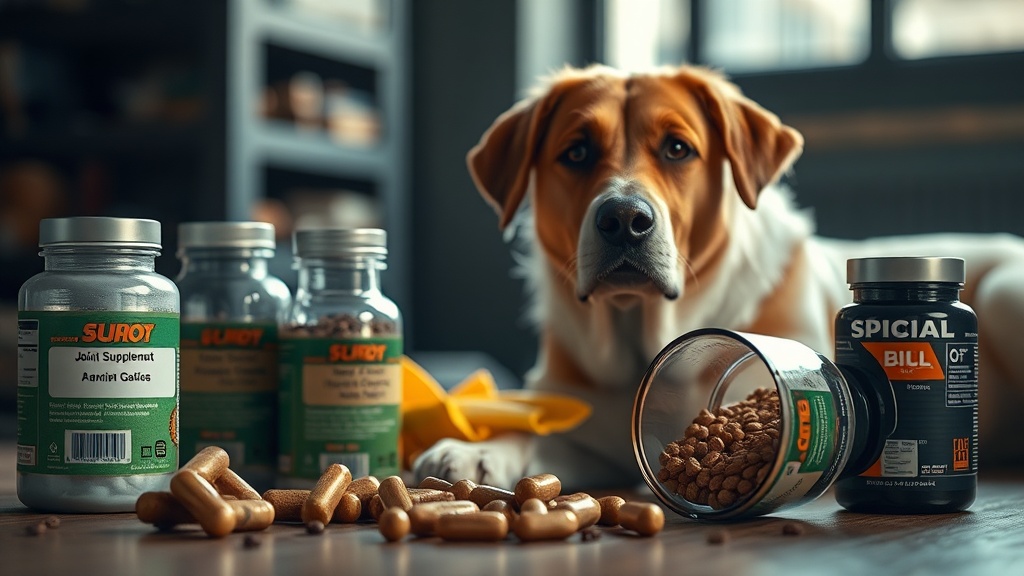
Lead is particularly insidious in joint supplements because it competes with calcium at bone metabolism sites. In a senior dog already experiencing cartilage degradation and subchondral bone remodeling, introducing even subclinical lead burden disrupts the very biological processes you’re paying to support.
Mercury contamination is most associated with fish oil and marine-derived ingredients — omega-3 supplements paired with joint formulas are especially high-risk if the fish oil isn’t molecularly distilled and tested. The counterintuitive finding is that “natural” sourcing labels can actually correlate with higher contamination, because synthetic manufacturing has tighter purity controls than raw marine harvesting.
Key Clinical Insight: A supplement that passes label accuracy testing can still fail safety testing. Third-party certification programs test for both — and a product needs to pass both to be genuinely safe for daily use in a senior large breed dog.
Species note: cats are not small dogs. Feline joint supplements carry different contamination risk profiles because they’re dosed at lower weights and metabolize certain compounds — particularly those processed hepatically — through pathways that large breed dogs do not share. What’s a marginal heavy metal burden for a 70-lb senior Rottweiler can be a significant one for a 10-lb senior Maine Coon.
The underlying reason contamination persists is market structure: the profit margin on pet supplements is high, testing is expensive, and regulatory consequences for non-compliance are minimal compared to human supplement enforcement.
How to Read a Label Like a Vet Tech
Knowing which certifications, ingredient forms, and sourcing disclosures to look for on a joint supplement label can meaningfully reduce your dog’s exposure to fraudulent and contaminated products.
When I evaluate a joint supplement label in the clinic, I’m looking for five things in sequence. Active ingredient form — glucosamine sulfate over HCl, chondroitin with stated purity percentage, omega-3 as EPA/DHA milligrams not just “fish oil” weight. Third-party certification — NSF International, USP Verified, or the National Animal Supplement Council (NASC) quality seal, which requires adverse event reporting and facility auditing. Country of origin for raw ingredients — not just where the product is manufactured. Heavy metal testing disclosure — either a certificate of analysis (COA) available on the manufacturer’s website or a direct statement of testing limits. Dosing transparency — the mg per dose for each active, not a “proprietary blend” weight that obscures individual compound amounts.
When you break it down, the absence of a COA on a manufacturer’s website is itself a red flag. Reputable producers test every batch and make those results public because transparency is their competitive advantage.
This depends on where you’re shopping: if you’re buying through your veterinarian’s dispensary or a veterinary-specific distributor, the vetting has largely been done for you. If you’re buying from a general pet retailer or an online marketplace with third-party sellers, you are personally responsible for that vetting. If your vet carries it, verify the brand still holds current certification — formulations and suppliers change.
A product without a NASC seal isn’t automatically dangerous. But a product that ticks none of these boxes — no certification, no COA, proprietary blend dosing, no ingredient sourcing disclosure — is a product that should not go into your senior dog’s body daily.
Signs to Watch For and When to Call the Clinic
Monitoring your senior large breed dog for signs of supplement-related toxicity is as important as monitoring for joint improvement — and several early warning signs are easy to miss.
Chronic heavy metal exposure in dogs doesn’t typically present with acute dramatic symptoms. It presents as a slow, quiet decline that owners often attribute to normal aging. Looking at the evidence, the earliest signs of cadmium or lead accumulation include increased water consumption and urination (early renal involvement), subtle GI changes like intermittent nausea or reduced appetite, and neurological micro-signs like slight incoordination or behavior changes. These are exactly the symptoms a senior large breed dog owner might write off as “just getting old.”
Signs to watch for specifically in dogs on daily joint supplements:
- Increased thirst or urination beyond their normal baseline
- Vomiting or soft stool occurring within 1-2 hours of supplement administration
- Pale gums, lethargy, or exercise intolerance that worsens despite supplementation
- Abnormal bloodwork on routine senior panels — particularly elevated BUN, creatinine, or liver enzymes
- Swollen or painful joints that worsen rather than improve over 6-8 weeks of consistent supplementation
When to see a vet instead of troubleshooting at home: If your senior large breed dog is showing any combination of increased thirst, GI upset, and joint symptoms that aren’t improving after 8 weeks on a supplement, request a full senior panel including a urinalysis. Ask your veterinarian specifically about heavy metal screening if the supplement brand cannot provide a current COA. Don’t wait for symptoms to become severe — in senior large breeds, organ reserve is already reduced and the window between “subclinical” and “crisis” is shorter than in younger dogs.
The NASC Quality Seal program offers a searchable database of certified member companies — cross-referencing your current supplement brand takes less than two minutes and is worth every second.
The data suggests that owners who proactively monitor bloodwork every 6 months on senior dogs taking daily supplements catch early organ changes significantly before dogs in the same demographic whose owners don’t supplement-monitor — giving time for intervention before damage is irreversible.
Choosing Safer: What Actually Works for Large Breed Senior Joints
Evidence-based joint support for senior large breed dogs centers on a short list of well-studied compounds at clinically meaningful doses — not the longest ingredient list or the boldest label claims.
The compounds with the most consistent evidence in canine joint health research are glucosamine sulfate (at 20mg/kg/day for large breeds), chondroitin sulfate (at 99%+ purity), omega-3 fatty acids as EPA and DHA specifically (not just ALA), and undenatured type II collagen (UC-II), which works through a different immune-mediated mechanism than glucosamine/chondroitin and is particularly promising in dogs who haven’t responded to traditional formulas. Curcumin and Boswellia serrata have supporting evidence for anti-inflammatory effects in dogs, but dosing standardization across products varies enormously — efficacy here depends entirely on the specific extract standardization listed on the label, not the herb name alone.
On closer inspection, the best large breed senior joint supplements tend to be simpler, not more complex. A five-ingredient formula from a NASC-certified manufacturer with published COAs will outperform a thirty-ingredient “advanced formula” from an unvetted source every single time — not because more is worse, but because manufacturing complexity increases contamination risk and reduces quality control precision.
Statistically, large breeds like German Shepherds, Labrador Retrievers, and Rottweilers show joint degeneration pathology starting as young as age 4-5, meaning supplementation conversations should begin well before the senior years — but the contamination and fraud risks apply across all life stages, not only seniors.
Choose boring. Choose certified. Choose transparent. Your dog’s joints will not recover from heavy metal nephrotoxicity the way they might recover from an ineffective supplement — one outcome is frustrating, the other is irreversible.
Frequently Asked Questions
How do I know if my dog’s current joint supplement contains heavy metals?
Request a certificate of analysis (COA) directly from the manufacturer — this document should list heavy metal testing results including lead, cadmium, mercury, and arsenic with batch-specific data. If the company cannot or will not provide a current COA, that is itself diagnostic information. You can also cross-reference the brand against ConsumerLab’s independent testing database, which has evaluated multiple pet supplement brands for heavy metal burden and label accuracy.
Are joint supplements safe for cats as well as large breed dogs?
This depends on the formulation versus the species. Cats have fundamentally different hepatic metabolism — they lack certain glucuronidation pathways that dogs use to process many compounds. Some joint supplement additives, including certain botanical anti-inflammatories, are safe for large breed dogs and potentially toxic to cats. Never assume a canine joint supplement is safe for feline use. Cats require species-specific formulations, and senior cat joint support should always be discussed with a veterinarian before starting.
What dose of glucosamine is actually effective for a large breed senior dog?
The evidence-supported dosing for glucosamine sulfate in dogs is approximately 20mg/kg/day, meaning a 30kg (66lb) senior Labrador requires around 600mg daily — and a 45kg (100lb) senior Rottweiler needs closer to 900mg. Many over-the-counter products dose for average dogs around 15-25kg and are functionally underdosed for large breeds even when the label is accurate. Always calculate dose by body weight, not the “small/medium/large” categories on the packaging, and verify the mg per dose is explicit — not hidden in a proprietary blend total.
References
- National Institutes of Health / NCBI PubMed — Heavy metal contamination in animal supplements: https://www.ncbi.nlm.nih.gov/pmc/articles/PMC6950580/
- National Animal Supplement Council (NASC) — Quality Seal Program: https://www.nasc.cc/pet-owners/quality-seal/
- ConsumerLab — Independent testing of pet supplements: https://www.consumerlab.com
- FDA Center for Veterinary Medicine — Pet dietary supplement guidance: https://www.fda.gov/animal-veterinary/products/animal-dietary-supplements
The single insight most owners leave a conversation like this without: the risk from a fraudulent joint supplement isn’t that it won’t help your dog’s joints — it’s that it may quietly damage the organs your dog needs to survive long enough to benefit from good joint care at all. The joints and the kidneys are not separate problems. In a senior large breed dog, they are the same problem wearing different symptoms.